
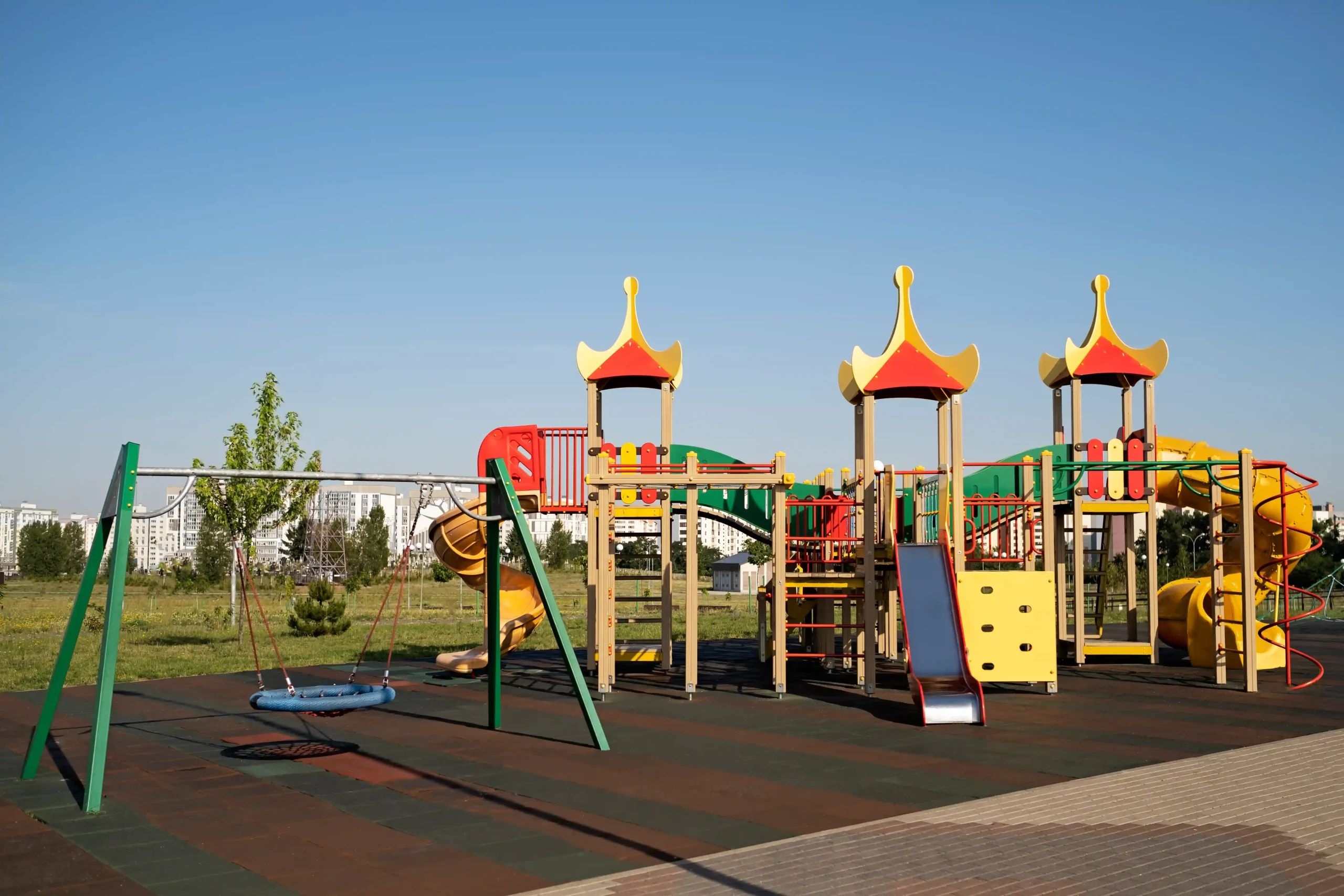
Hardstandings: Floorings, Parking Lots, Taxiways, Playgrounds etc.
SFRC
The use of Steel Fibre Reinforced Concrete (SFRC) for concrete floors has increased significantly in the last couple of decades. However, only a few engineers understand, evaluate and use them well. Engineers involved in a SFRC slab project should use the toughness value as a comparative parameter as well as a design parameter. Also the toughness value should be included in the specifications as well as the slab thickness, the dosage and the type of steel fibres that corresponds to it.
Cracking control of plain concrete slabs on soil foundation requires the execution of joints with mechanisms of load transfer between adjacent panels. These joints increase the construction costs and, often, are the source of local damage and loss of service performance. SFRC has also been economically competitive in industrial floors, when compared with conventional reinforced concrete, since it eliminates the time needed to place the mesh reinforcement to keep it in position during concrete casting. In areas where jointless floors are required, SFRC is the go-to solution.
Steel Fibre reinforced concrete is a smart material well fitted for applications in industrial floors on soil foundation. The cost of fibres is compensated by a faster construction process and a reduction in the number of expansion joints. The fatigue, impact and flexural strength are significantly improved when steel fibres are added to the concrete mix.
Industrial floors are the type of structures wherein the application of steel fibre reinforced concrete (SFRC) is advantageous. During the service life these structures are subjected to cyclic and impact loads, requiring adequate fatigue flexural strength and energy absorption capacity.
All published research has corroborated that the addition of steel fibres to concrete improve the toughness and the resistance to dynamic, cyclic and impact loads, and reduces the crack width and spacing. The degree of improvement depends on the type and aspect ratio (length to diameter ratio) of the steel fibres. In comparison to plain concrete solution, SFRC pavement can be 30-40% thinner, resulting in further savings.
Economic Advantages
- Faster cheaper construction (From 10-30% less usually)
- Slab is less thick so less concrete
- No wire mesh installation and less people needed.
- Faster concrete pouring, especially with laser screed equipment
- It is possible to do more surface in one day.
- It is possible to reduce number of saw-cuts.
- Lesser joint spacing
- Cleaner, sharper edges
- Less maintenance of the slab (less cracks, fewer saw cuts, better fatigue and impact resistance, etc.)
Toughness of SRFC
The main advantage of SFRC and the most useful one regarding design of slabs on ground is the post crack behavior or toughness of SFRC. Steel Fibres start acting when the first crack appears and can absorb and redistribute the loads so that the SFRC will still be able to bear loads even after the formation of cracks. SFRC exhibits ductility and toughness, so its additional flexural capacity after cracking can be applied in structural design situations where controlling deformation is important. It is the reason, for the same thickness, a SFRC slab on ground can support higher loads than a conventional concrete slab.
Key Benefits
Withstands container and truck loads.
Reduces joint failures and slab cracking.
Improve abrasion and wear resistance.
Faster construction without mesh placement
Typical Applications
Container yards and ports
Truck terminals and parking lots
Airport aprons
Industrial storage yards
Quality G Compliance
ASTM A820, EN 14889-1
Suggested Dosage
15–40 kg/m³
Recommended Fiber Types
Round Crimped Steel Fibers
Hooked-End Steel Fibers
Flat Crimped Steel Fibers